
By David Hall, Chief Technology Officer at Tillion
When choosing a location for AI infrastructure, conversations often focus on renewable energy, cooling and power availability. But if your services need to reach users across Europe, Africa and beyond, latency becomes just as important. Comparing Zaragoza and the Nordics reveals how geography can significantly influence network performance and why location remains a strategic decision in the AI era.
CTO, David Hall gives his insight on the matter.

Over the past few weeks I’ve been looking at a question that comes up frequently in data centre conversations:
If you’re serving a global audience, is a Nordic location really the optimal place to build digital infrastructure, or does somewhere like Zaragoza provide a more balanced latency profile?
The conventional wisdom is that the Nordics are the natural choice because of abundant renewable energy, excellent cooling conditions and a growing concentration of hyperscale infrastructure.
But when you look at latency through the lens of where people actually live and where future demand is likely to come from, the answer becomes more nuanced.
Looking beyond Europe
Most latency discussions focus on Western Europe alone.
However, if the target audience includes:
- Europe
- North Africa
- West Africa
- The Middle East
- The Americas
then the geographical centre of demand starts to shift south and west.
That is where Zaragoza becomes interesting.
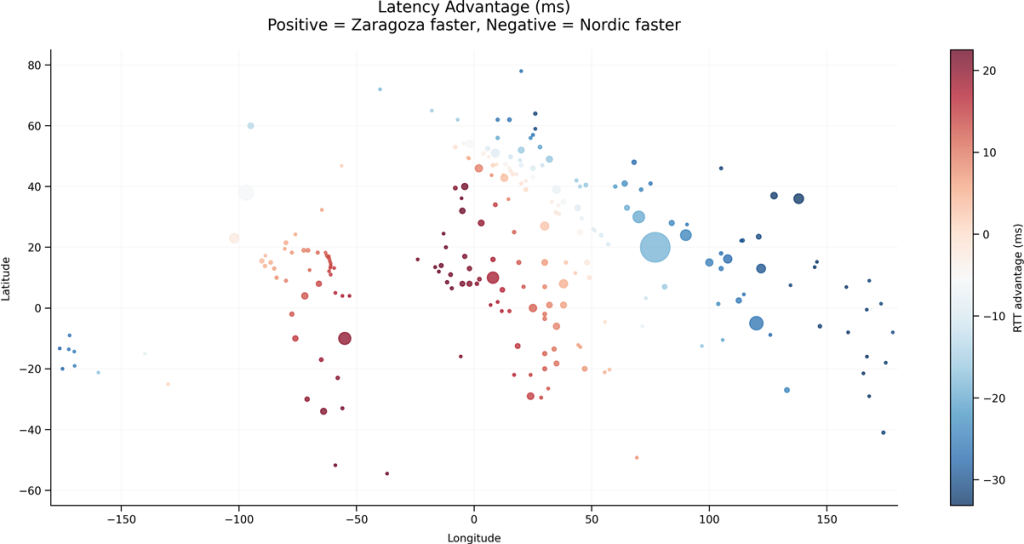
When we model round-trip latency bands from Zaragoza against a Nordic comparator (using the best-performing location of Stockholm, Copenhagen, Oslo or Helsinki), a very different picture emerges.
Europe–Africa latency envelope
Zaragoza RTT bands
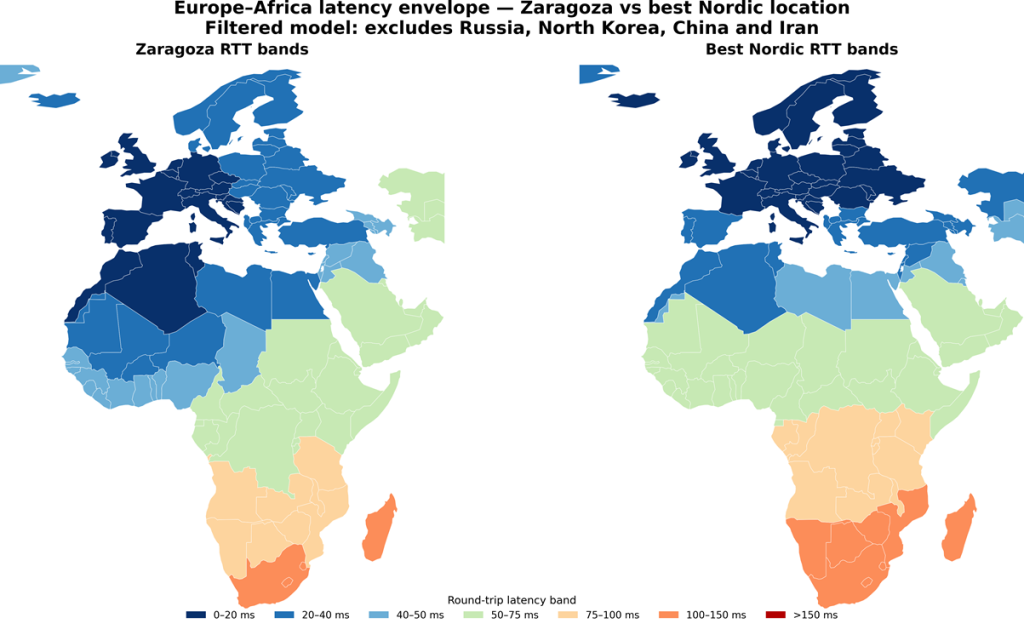
The map below compares latency bands across Europe and Africa for:
- Zaragoza (left)
- Best Nordic location (right)
Countries shaded in darker blue sit within the lowest latency bands, while green, orange and red represent progressively higher RTTs.
A number of observations stand out immediately:
- ✅ Iberia benefits significantly from Zaragoza
- ✅ North Africa moves into lower latency bands
- ✅ West Africa benefits materially
- ✅ The Nordics outperform for Northern Europe and Asia-facing corridors
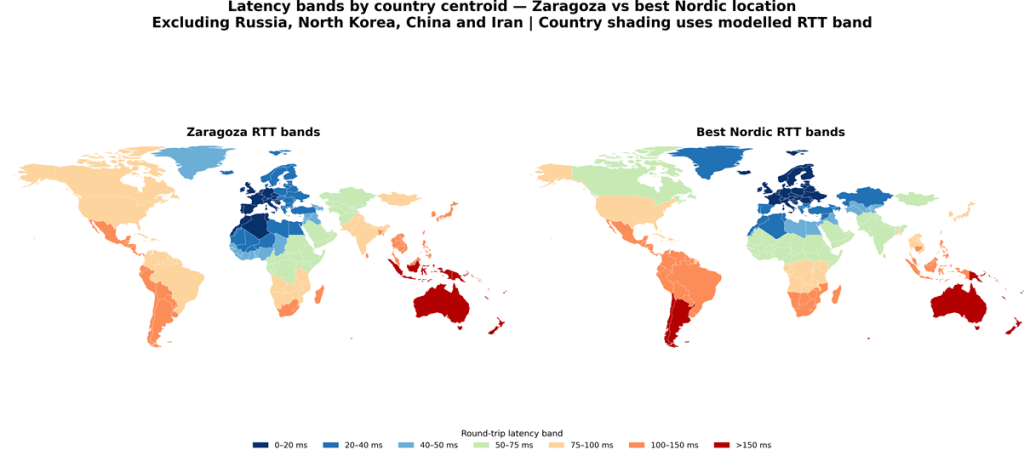
The important metric isn’t landmass. It’s people.
One of the lessons from this exercise is that geographic maps can be misleading.
Large countries dominate the visual area of a map, even when relatively few people live there.
What matters for digital infrastructure is:
How many people can be served within a given latency threshold?
In the filtered model (excluding Russia, China, Iran and North Korea), Zaragoza demonstrates a meaningful advantage in the most commercially relevant latency ranges.
40–50 ms RTT
Zaragoza serves substantially more population within a 40–50 ms envelope than the Nordic comparator.
This appears particularly relevant for:
- Southern Europe
- North Africa
- West Africa
- Atlantic-facing markets
where growth in digital demand is likely to remain strong over the coming decade.
50 ms RTT
The analysis suggests that Zaragoza serves approximately 281 million more people within a 50 ms RTT envelope than the best Nordic comparator in the filtered model.
That is a surprisingly large figure given how frequently the Nordics are positioned as the default answer for European infrastructure.
What the Nordics still do exceptionally well
This isn’t an argument against the Nordics.
The Nordic region remains highly attractive because of:
✅ Power availability
✅ Renewable energy mix
✅ Cooling efficiency
✅ Proximity to Northern European users
✅ Strong connectivity towards Asia
For workloads that are heavily concentrated in:
- Scandinavia
- The Baltics
- Central and Eastern Europe
- Asia-facing traffic corridors
a Nordic deployment remains a very compelling option.
.
What Zaragoza optimises for
Zaragoza sits in a different position.
It is closer to the intersection of:
- Europe
- Africa
- Atlantic connectivity
- Southern European demand
That creates a different optimisation profile:
✅ Strong coverage of European population centres
✅ Better access to North and West African demand
✅ Favourable positioning for Atlantic traffic
✅ Competitive latency across much of continental Europe
In other words:
Zaragoza is not a compromise. It is a different optimisation point.
The bigger lesson
As AI infrastructure, cloud regions and digital services continue to globalise, we may need to rethink some of the assumptions we’ve inherited from the previous generation of data centre development.
Energy matters.
Land matters.
Connectivity matters.
But geography still matters too.
And when the objective is not simply serving Northern Europe, but rather serving a broader Europe–Africa–Atlantic demand profile, locations like Zaragoza deserve far more attention than they often receive.
The question is no longer:
“Where is the coldest place to build?”
The more interesting question might be:
“Where is the best place to serve the next billion users?”